

|
The great reptiles were the most successful life-forms ever to populate this world. For 140 million years they rules the Earth, filled the sky, swarmed in the seas. At this time the mammals, the ancestors of mankind, were only tiny, shrew-like animals that were preyed upon by the larger, faster, more intelligent saurians. Then, 65 million years ago, all this changed. A meteor six miles in diameter struck the Earth and caused disastrous atmospheric upheavals. Within a brief span of time over seventy-five percent of all the species then existent were wiped out. The age of the dinosaurs was over; the evolution of the mammals that they had suppressed for 100 million years began. But what if that meteor had not fallen? What would the world be like today?
Prologue: KerrickI have read the pages that follow here and I honestly believe them to be a true history of the world. Not that belief was easy to come by. It might be said that my view of the world was a restricted one. I was born in a small encampment made up of three families. During the warm season we stayed on the shore of a great lake rich with fish. My first memories are of that lake, looking across its still water at the high mountains beyond, seeing their peaks grow white with the first snows of winter. When the snow whitened our tents and the grass around as well, that would be the time when the hunters went to the mountains. I was in a hurry to grow up, eager to hunt the deer, and the greatdeer, at their side. That simple world of simple pleasures is gone forever. Everything has changed - and not for the better. At times I wake at night and wish that what happened had never happened. But these are foolish thoughts and the world is as it is, changed now in every way. What I thought was the entirety of existence has proved only to be a tiny corner of reality. My lake and my mountains are only the smallest part of a great continent that stretches between two immense oceans. I knew of the western ocean because our hunters had fished there. I also knew about the murgu and learned to hate them long before I ever saw them. As our flesh is warm, so is theirs cold. We have hair upon our heads and a hunter will grow a proud beard, while the animals that we hunt have warm flesh and fur or hair, but this is not true of the murgu. They are cold and smooth and scaled, have claws and teeth to rend and tear, are large and terrible, to be feared. And hated. I knew that they lived in the warm waters of the ocean to the south and on the warm lands to the south. They could not abide the cold and so did not trouble us. All that has changed and changed so terribly that nothing will ever be the same again. It is my unhappy knowledge that our world is only a tiny part of the murgu world. We live in the north of a great continent that is joined to a great southern continent. And on all of this land, from ocean to ocean, there swarm only murgu. And there is even worse. Across the western ocean there are even larger continents - and there there are no hunters at all. None. But murgu, only murgu. The entire world is theirs except for our small part. Now I will tell you the worst thing about the murgu. They hate us just as we hate them. This would not matter if they were only great, insensate beasts. We would stay in the cold north and avoid them in this manner. But there are those murgu who may be as intelligent as hunters, as fierce as hunters. And their number cannot be counted but it is enough to say that they fill all the lands of this great globe. What follows here is not a nice thing to tell, but it happened and must be told. This is the story of our world and all of the creatures that live in it and
what happened when a band of hunters ventured south along the coast and what
they found there. And what happened when the murgu-who-fill-the-world discovered
that the world was not theirs alone, as they had always believed.
Chapter One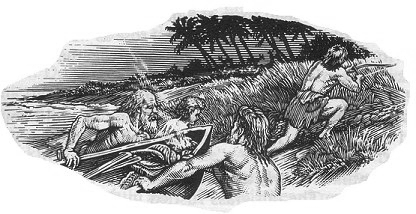
Isizzó fa klabra massik, den sa runyur owot meth alpi. Spit in the teeth of winter, for he always dies in the spring.
Amahast was already awake when the first light of approaching dawn began to spread across the ocean. Above him only the brightest stars were still visible. He knew them for what they were; the tharms of the dead hunters who climbed into the sky each night. But now even these last ones, the best trackers, the finest hunters, even they were fleeing before the rising sun. It was a fierce sun here this far south, burningly different from the northern sun that they were used to, the one that rose weakly into a pale sky above the snow-filled forests and the mountains. This could have been another sun altogether. Yet now, just before sunrise, it was almost cool here close the water, comfortable. It would not last. With daylight the heat would come again. Amahast scratched at the insect bites on his arm and waited for dawn. The outline of their wooden boat emerged slowly from the darkness. It had been pulled up onto the sand, well beyond the dried weed and shells that marked the reach of the highest tide. Close by it he could just make out the dark forms of the sleeping members of his sammad, the four who had come with him on this voyage. Unasked, the bitter memory returned that one of them, Diken, was dying; soon they would be only three. One of the men was climbing to his feet, slowly and painfully, leaning heavily on his spear. That would be old Ogatyr; he had the stiffness and ache in his arms and legs that comes with age, from the dampness of the ground and the cold grip of winter. Amahast rose as well, his spear also in his hand. The two men came together as they walked towards the water holes. "The day will be hot, kurro," Ogatyr said. "All of the days here are hot, old one. A child could read that fortune. The sun will cook the pain from your bones" They walked slowly and warily towards the black wall of the forest. The tall grass rustled in the dawn breeze; the first waking birds called in the trees above. Some forest animal had eaten the heads off the low palm trees here, then dug beside them in the soft ground to find water. The hunters had deepened the holes the evening before and now they were brimming with clear water. "Drink your fill," Amahast ordered, turning to face the forest. Behind him Ogatyr wheezed as he dropped to the ground, then slurped greedily. It was possible that some of the creatures of the night might still emerge from the darkness of the trees so Amahast stood on guard, spear pointed and ready, sniffing the moist air rich with the odor of decaying vegetation, yet sweetened by the faint perfume of nightblooming flowers. When the older man had finished he stood watch while Amahast drank. Burying his face deep in the cool water, rising up gasping to splash handfuls over his bare body, washing away some of the grime and sweat of the previous day. "Where we stop tonight, that will be our last camp. The morning after we must turn back, retrace our course," Ogatyr said, calling over his shoulder while his eyes remained fixed on the bushes and trees before him. "So you have told me. But I do not believe that a few days more will make any difference!" "It is time to return. I have knotted each sunset onto my cord. The days are shorter, I have ways of knowing that. Each sunset comes more quickly, each day the sun weakens and cannot climb as high into the sky. And the wind is beginning to change, even you must have noticed that. All summer it has blown from the southeast. No longer. Do you remember last year, the storm that almost sank the boat and blew down a forest of trees? The storm came at this time. We must return. I can remember these things, knot them in my cord." "I know you can, old one" Amahast ran his fingers through the wet strands of his uncut hair. It reached below his shoulders, while his full blonde beard rested damply on his chest. "But you also know that our boat is not full." "There is much dried meat ..." "Not enough. We need more than that to last the winter. The hunting has not been good. That is why we have journeyed farther south than we ever have before. We need the meat." "One single day, then we must return. No more than that. The path to the mountains is long and the way hard." Amahast did not speak in answer. He respected Ogatyr for all the things that the old man knew, his knowledge of the correct way to make tools and find magic plants. The oldster knew the rituals needed to prepare for the hunt, as well as the chants that could ward off the spirits of the dead. He had all of the knowledge of his lifetime and of the lifetimes before him, the things that he had been told and that he remembered, that he could recite from the rising of the sun in the morning to the setting at night and still not be done. But there were new things that the old one did not know about, and these were what troubled Amahast, that demanded new answers. It was the winters that were the cause of it, the fierce winters that would not end. Twice now there had been the promise of spring as the days had grown longer, the sun brighter - but spring had never come. The deep snows had not melted, the ice on the streams stayed frozen. Then there had been hunger. The deer and the greatdeer had moved south, away from their accustomed valleys and mountain meadows that now stayed tight-locked in winter's unyielding grip. He had led the people of his sammad as they had followed the animals, they had to do that or starve, down from the mountains to the broad plains beyond. Yet the hunting had not been good, for the herds had been thinned out by the terrible winter. Nor was their sammad the only one that had troubles. Other sammads had been hunting there as well, not only ones that his people were joined to by marriage, but sammads they had never seen before. Men who spoke Marbak strangely, or not at all, and pointed their spears in anger. Yet all of the sammads were Tanu, and Tanu never fought Tanu. Never before had they done this. But now they did and there was Tanu blood on the sharp stone points of the spears. This troubled Amahast as much as did the endless winter. A spear for hunting, a knife for skinning, a fire for cooking. This was the way it had always been. Tanu did not kill Tanu. Rather than commit this crime himself he had taken his sammad away from the hills, marching each day towards the morning sun, not stopping until they had reached the salt waters of the great sea. He knew that the way north was closed, for the ice there came to the ocean's edge and only the Paramutan, the skin-boat people, could live in those frozen lands. The way south was open but there, in the forests and jungles where the snow never came, were the murgu. And where they were was death. So only the wave-filled sea remained. His sammad had long known the art of making wooden boats for summer fishing, but never before had they ventured out of sight of land or away from their camp upon the beach. This summer they must. The dried squid would not last the winter. If the hunting were as bad as that of the winter before then none of them would be alive in the spring. South, then, it must be south, and that was the way they had gone. Hunting along the shore and on the islands off the coast, in fear always of the murgu. The others were awake now. The sun was above the horizon and the first shrieks of the animals were sounding from the depths of the jungle. It was time to put to sea. Amahast nodded solemnly when Kerrick brought him the skin bag of ekkotaz, then dipped out a handful of the thick mass of crushed acorns and dried berries. He reached out with his other hand and ruffled the thick mat of hair on his son's head. His firstborn. Soon to be a man and take a man's name. But still a boy, although he was growing strong and tall. His skin, normally pale, was tanned golden now since, like all of them on this voyage, he wore only a deerskin tied at his waist. About his neck, hung from a leather thong, there was a smaller version of the skymetal knife that Amahast also wore. A knife that was not as sharp as stone but was treasured for its rarity. These two knives, the large and small, were the only skymetal the sammad possessed. Kerrick smiled up at his father. Eight years old and this was his first hunt with the men. It was the most important thing that had ever happened to him. "Did you drink your fill?" Amahast asked. Kerrick nodded. He knew there would be no more water until nightfall. This was one of the important things that a hunter had to learn. When he had been with the women - and the children - he had drunk water whenever he had felt thirsty, or if he had been hungry he had nibbled at the berries or eaten the fresh roots as they dug them up. No more. He went with the hunters now, did what they did, went without food and drink from before sunrise until after dark. He gripped his small spear proudly and tried not to start with fright when something crashed heavily in the jungle behind him. "Push out the boat," Amahast ordered. The men needed no urging; the sounds of the murgu were growing louder, more threatening. There was little enough to load into the boat, just their spears, bows and quivers of arrows, deerskins and bags of ekkotaz. They pushed the boat into the water and big Hastila and Ogatyr held it steady while the boy climbed in carefully holding a large shell that contained glowing embers from the fire. Behind them on the beach Diken struggled to rise, to join the others, but he was not strong enough today. His skin paled with the effort and great drops of perspiration stood out on his face. Amahast came and knelt beside him, took up a corner of the deerskin that he was lying on and wiped the wounded man's face. "Rest easy. We'll put you into the boat." "Not today, not if I cannot climb aboard myself!" Diken's voice was hoarse, he gasped with the effort of speech. "It will be easier if I wait here for your return. It will be easier on my hand." His left hand was now very bad. Two fingers had been bitten, torn away, when a large jungle creature had blundered into their camp one night, a half-seen form that they had wounded with spears and driven back into the darkness. At first Diken's wound had not looked too serious, hunters had lived with worse, and they had done all the things for him that could be done. They had washed the wound in sea water until it bled freely, then Ogatyr had bound it up with a poultice made from the benseel moss that had been gathered in the high mountain bogs. But this time it had not been enough. The flesh had grown red, then black, and finally the blackness had spread up Diken's arm; its smell was terrible. He would die soon. Amahast looked up from the swollen arm to the green wall of the jungle beyond. "When the beasts come my tharm will not be here to be consumed by them," Diken said, seeing the direction of Amahast's gaze. His right hand was clenched into a fist; he opened and closed it briefly to disclose the flake of stone concealed there. The kind of sharp chip that was used to butcher and skin an animal. Sharp enough to open a man's vein. Amahast rose slowly and rubbed the sand from his bare knees. "I will look for you in the sky." he said, his expressionless voice so low that only the dying man could hear it. "You were always my brother," Diken said. When Amahast left he turned
his face away and closed his eyes so he would not see the others leave and perhaps
give some sign to him. The low, grass covered island lay close offshore and sheltered the beach here from the strength of the ocean waves. Further to the south it rose higher, above the salt spray of the sea, and there the trees began. With grass and shelter there was the promise of good hunting. Unless the murgu were here as well. "Look, in the water!" Kerrick called out, pointing down at the sea. An immense school of hardalt was passing beneath them, tentacles trailing, their seemingly numberless, boneless bodies protected by their shells. Hastila seized up his spear by the butt end and poised it over the water. He was a big man, taller even than Amahast, yet very quick for all of that. He waited a moment - then plunged the spear down into the sea, deep down until his arm was in the water, then heaved upward. His point had struck true, into the soft body behind the shell, and the hardalt was pulled from the water and dumped into the bottom of the boat where it lay, tentacles writhing feebly, black dye oozing from its punctured sack. They all laughed at that. He was truly named, Hastila, spear-in-hand. A spear that did not miss. "Good eating," Hastila said, putting his foot on the shell and pulling his spear free of the body. Kerrick was excited. How easy it looked. A single quick thrust - and there was a great hardalt, enough food to feed them all for a day. He took his own spear by the butt, just as Hastila had done. It was only half the length of the hunter's spear but the point was just as sharp. The hardalt were still there, thicker than ever, one of them roiling the surface just below the bow. Kerrick thrust down, hard. Feeling the point sink into flesh. Seizing the haft with both hands and pulling up. The wooden shaft shook and tore at his hands but he held on grimly, tugging with all of his strength. There was a great thrashing of foam in the water as the wet-shining head rose up beside the boat. His spear tore free of the thing's flesh and Kerrick fell backwards as the jaws opened, rows of teeth before him, a screeching roar so close the stinking breath of the creature washed over him. Sharp claws scratched at the boat, tore pieces from the wood. Then Hastila was there, his spear plunging between those terrible jaws, once, twice. The marag screamed louder and a gush of blood spattered the boy. Then the jaws closed and, for an instant, Kerrick looked into that round unblinking eye poised before his face. A moment later it was gone, sinking beneath the surface in a flurry of bloody foam. "Pull for the island," Amahast ordered. "There will be more of these beasts, bigger ones, following after the hardalt. Is the boy hurt?" Ogatyr splashed a handful of water on Kerrick's face and rubbed it clean. "Just frightened," he said looking at the drawn face. "He is lucky," Amahast said grimly. "Luck comes only once. He will never thrust a spear into darkness again." Never! Kerrick thought, almost shouting the word aloud, looking at the torn wood where the thing's claws had raked deep. He had heard about the murgu, seen their claws on a necklace, even touched a smooth and multicolored pouch made from the skin of one of them. But the stories had never really frightened him; tall as the sky, teeth like spears, eyes like stones, claws like knives. But he was frightened now. He turned to face the shore, sure that there were tears in his eyes and not wanting the others to see them, biting his lips as they slowly approached the land. The boat was suddenly a thin shell above a sea of monsters and he desperately wanted to be on solid ground again. He almost cried aloud when the prow grated against the sand. While the others pulled the boat out of the water he washed away all traces of the marag's blood. Amahast made a low hissing sound between his teeth, a hunter's signal, and they all froze, silent and motionless. He lay in the grass above them, peering over the rise. He motioned them flat with his hand, then signalled them forward to join him. Kerrick did as the others did, not rising above the grass, but carefully parting the blades with his fingers so he could look between them. Deer. A herd of the small creatures was grazing just an arrow-shot away. Plump with the rich grass of the island, moving slowly, long ears twitching at the flies that buzzed about them. Kerrick sniffed through widened nostrils and could smell the sweetness of their hides. "Go silently along the shore," Amahast said. "The wind is blowing from them towards us, they will not smell us. We will get close." He led the way, crouching as he ran, and the others followed, Kerrick bringing up the rear. They notched their arrows while still bent low behind the bank, drew their bows, then stood and let fly together. The flight of arrows struck true; two of the creatures were down and a third wounded. The small buck was able to stagger some distance with the arrow in its body. Amahast ran swiftly after it and closed on the creature. It turned at bay, its tiny span of horns lowered menacingly and he laughed and jumped towards it, seized the horns in his hands and twisted. The creature snorted and swayed, then bleated as it fell. Amahast arched its neck back as Kerrick ran up. "Use your spear, your first kill. In the throat - to one side, stab deep and twist." Kerrick did as he was bid and the buck bellowed in agony as the red blood burst out drenching Kerrick's hands and arms. Blood to be proud off. He pushed the spear deeper into the wound until the creature shuddered and died. "A good kill" Amahast said proudly. The way that he spoke made Kerrick hope that the marag in the boat would not be talked about again. The hunters laughed with pleasure as they opened and gutted the carcasses. Amahast pointed south towards the higher part of the island. "Take them to the trees where we can hang them to drain." "Will we hunt again?" Hastila asked. Amahast shook his head. "Not if we are to return tomorrow. It will take the day and the night to butcher and smoke what we have here." "And to eat," Ogatyr said, smacking his lips loudly. "Eat our fill. The more we put into our stomachs the less we will have to carry on our backs!" Though it was cooler under the trees they were soon crawling with biting flies. They could only beat at them and plead with Amahast for the smoke to keep them at bay. "Skin the carcasses" he ordered, then kicked a fallen log with his toe: it fell to pieces. "Too damp. The wood here under the trees is too wet to burn. Ogatyr, bring the fire from the boat and feed it with dry grass until we return. I will take the boy and get some driftwood from the beach." He left his bow and arrows behind, but took up his spear and started off through the grove towards the ocean side of the island. Kerrick did the same and hurried after him. The beach was wide, the fine sand almost as white as snow. Offshore the waves broke into a rumble of bubbling froth that surged far up the beach towards them. At the water's edge were bits of wood and broken sponges, endless varicolored shells, violet snails, great green lengths of seaweed with tiny crabs clinging to them. The few small pieces of driftwood here were too tiny to bother with, so they walked on to the headland that pushed a rocky peninsula out into the sea. When they had climbed the easy slope they could look out between the trees to see that the headland curved out and around to make a sheltered bay. On the sand at the far side dark forms, they might be seals, basked in the sun. At the same moment they became aware that someone was standing under a nearby tree, also looking out over the bay. Another hunter perhaps. Amahast had opened his mouth to call out when the figure stepped forward into the sunlight. The words froze in his throat; every muscle in his body locked hard. No hunter, no man, not this. Man-shaped but repellently different in every way. The creature was hairless and naked, with a colored crest that ran across the top of its head and down its spine. It was bright in the sunlight, obscenely marked with a skin that was scaled and multi-colored. A marag. Smaller than the giants in the jungle, but a marag nevertheless. Like all of its kind it was motionless at rest, as though carved from stone. Then it turned its head to one side, a series of small jerking motions, until they could see its round and expressionless eye, the massive out-thrust jaw. They stood, as motionless as murgu themselves, gripping their spears tightly, unseen, for the creature had not turned far enough to notice their silent forms among the trees. Amahast waited until its gaze went back to the ocean before he moved. Gliding forward without a sound, raising his spear. He had reached the edge of the trees before the beast heard him or sensed his approach. It snapped its head about, stared directly into his face. The hunter plunged the stone head of his spear into one lidless eye, through the eye and deep into the brain behind. It shuddered once, a spasm that shook its entire body, then fell heavily. Dead before it hit the ground. Amahast had the spear pulled free even before that, had spun about and raked his gaze across the slope and the beach beyond. There were no more of the creatures nearby. Kerrick joined his father, standing beside him in silence as they looked down upon the corpse. It was a crude and disgusting parody of human form. Red blood was still seeping from the socket of the destroyed eye, while the other stared blankly up at them, its pupil a black, vertical slit. There was no nose; just flapped openings where a nose should have been. Its massive jaw had dropped open in the agony of sudden death to reveal white rows of sharp and pointed teeth. "What is it?" Kerrick asked, almost choking on the words. "I don't know. A marag of some kind. A small one, I have never seen its like before!" "It stood, it walked, like it was human, Tanu. A murgu, father, but it has hands like ours!" "Not like ours. Count. One, two, three fingers and a thumb. No, it has only two fingers - and two thumbs!" Amahast's lips were drawn back from his teeth as he stared down at the thing. Its legs were short and bowed, the feet flat, the toes claw-tipped. It had a stumpy tail. Now it lay curled in death, one arm beneath its body. Amahast dug at it with his toe, turned it over. More mystery, for clutched in its hand he could now see what appeared to be a length of knobbed black wood. "Father - the beach!" Kerrick called out. They sought shelter under the trees and watched from concealment as the creatures emerged from the sea just below the spot where they stood. There were three of the murgu. Two of them very much like the one that had been killed. The third was bigger, fat and slow-moving. It lay half in and half out of the water, lolling on its back, eyes closed and limbs motionless. The other two pushed at it, rolling it further up on the sand. The large creature bubbled through its breathing flaps, then scratched its stomach with the claws on one foot, slowly and lazily. One of the smaller murgu thrashed its paws about in the air and made a sharp clacking sound. Anger rose up in Amahast's throat, choking him so that he gasped aloud. Hatred almost blinded him as, with no conscious volition, he hurled himself down the slope with his spear thrust out before him. He was upon the creatures in a moment, stabbing at the nearest one. But it had moved aside as it turned and the stone point only tore through its side, glancing off its ribs. The beast's mouth gaped and it hissed loudly as it tried to flee. Amahast's next blow struck true. Amahast pulled the spear free, turned to see the other one splashing into the water, escaping. Throwing its arms wide and falling as the small spear hurtled through the air and caught it in the back. "A good throw," Amahast said, making sure the thing was dead before wrenching the spear free and handing it back to Kerrick. Only the large marag remained. Its eyes were closed and it seemed oblivious to what was happening around it. Amahast's spear plunged deep into its side and it emitted an almost human groan. The creature was larded with fat and he had to stab again and again before it was still. When he was done Amahast leaned on his spear, panting heavily, looking with disgust at the slaughtered creatures, hatred still possessing him. "Things like these, they must be destroyed. The murgu are not like us, see their skin, scales. None of them has fur, they fear the cold, they are poison to eat. When we find them we must destroy them." He snarled out the words and Kerrick could only nod agreement, feeling the same deep and unthinking repulsion. "Go, get the others," Amahast said. "Quickly. See, there, on the other side of the bay, there are more of these. We must kill them all." A movement caught his eye and he drew back his spear thinking the creature not yet dead. It was moving its tail. No! The tail itself was not moving, but something was writhing obscenely beneath the skin at its base. There was a slit there, an opening of some kind. A pouch in the base of the beast's thick tail. With the point of his spear Amahast tore it open, then struggled against the desire to retch at the sight of the pallid creatures that tumbled out onto the sand. Wrinkled, blind, tiny imitations of the adults. Their young, they must be. Roaring with anger he trampled them underfoot. "Destroyed, all of them, destroyed." He mumbled the words over and over and Kerrick fled away among the trees.
Chapter Two
Enge hantèhei, atè embokèke iirubushei kaksheisè, hèeawahei; hèvai'ihei, kaksheinte, enpeleiuu asahen enge. To leave father's love and enter the embrace of the sea is the first pain of life - the first joy is the comrades who join you there.
The enteesenat cut through the waves with rhythmic motions of their great, paddle-like flippers. One of them raised its head from the ocean, water streaming from its dark hide, rising it higher and higher on its long neck, turning and looking backward. Only when it caught sight of the great form low in the water behind them did it drop beneath the surface once again. There was a school of squid ahead - the other enteesenat was clicking with loud excitement. Now the massive lengths of their tails thrashed and they tore through the water, gigantic and unstoppable, their mouths gaping wide. Into the midst of the school. Spurting out jets of water the squid fled in all directions. Most would escape behind the clouds of black dye they expelled, but many of them were snapped up by the plateridged jaws, caught and swallowed whole. This continued until the sea was empty again, the survivors scattered and distant. Sated, the great creatures turned about and paddled slowly back the way they had come. Ahead of them an even larger form moved through the ocean, water surging across its back and bubbling about the great dorsal fin of the uruketo. As they neared it the enteesenat dived and turned to match its steady motion through the sea, swimming beside it close to the length of its armored beak. It must have seen them, one eye moved slowly, following their course, the blackness of the pupil framed by its bony ring. Recognition slowly penetrated the creature's dim brain and the beak began to open, then gaped wide. One after another they swam to the wide open mouth and pushed their heads into the cave-like opening. Once in position they regurgitated the recently caught squid. Only when their stomachs were empty did they pull back and spin about with a sideways movement of their flippers. Behind them the jaws closed as slowly as they had opened and the massive bulk of the uruketo moved steadily on its way. Although most of the creatures massive body was below the surface, the uruketo's dorsal fin projected above its back, rising up above the waves. The flattened top was dried and leathery, spotted with white excrement where sea birds had perched, scarred as well where they had torn the tough hide with their sharp bills. One of these birds was dropping down towards the top of the fin now, hanging from its great white wings, webbed feet extended. It squawked suddenly, flapping as it moved off, startled by the long gash that had appeared in the top of the fin. This gap widened, then extended the length of the entire fin, a great opening in the living flesh that widened further still and emitted a puff of stale air. The opening gaped, wider and wider, until there was more than enough room for the Yilanè to emerge. It was the second officer, in charge of this watch. She breathed deeply of the fresh sea air as she clambered onto the wide ledge of bone located inside and near the top of the fin, her head and shoulders projecting, looking about in a careful circle. Satisfied that all was well she clambered back below, past the crewmember on steering duty who was peering forward through the transparent disc before her. The officer looked over her shoulder at the glowing needle of the compass, saw it move from the coursemark. The crewmember reached out next to the compass and seized the nodule of the nerve ending between the thumbs of her left hand, squeezing it hard. A shudder passed through the vessel as the half-sentient creature responded. The officer nodded and continued her climb down into the long cavern of the interior, her pupils expanding swiftly in the half-lit darkness. Fluorescent patches were the only illumination here in the living-walled chamber that extended almost the full length of the uruketo's spine. To the rear, in almost complete darkness, lay the prisoners with their ankles shackled together. Cases of supplies and pods of water separated them from the crew and passengers in the front. The officer made her way forward to the commander to give her report. Erefnais looked up from the glowing chart that she held and signed agreement. Satisfied, she rolled the chart and returned it to its niche, then moved off to climb the fin herself. She shuffled when she walked, a childhood injury to her back which was still scarred and wrinkled from the same wound. Only her great ability had enabled her to rise to this high rank with such a disfiguring handicap. When she emerged on top of the fin she also breathed deep of the fresh air as she looked about her. Behind them the coast of Maninlè was slipping out of sight. There was land barely visible on the horizon ahead, a chain of low islands stretching northwards. Satisfied, she bent over and spoke, expressing herself in the most formal way. When issuing orders she would be more direct, almost brusque. But not now. She was polite and impersonal, the accepted form of address to be used by one of lower rank to one of higher. Yet she was in command of this living vessel - so the one she spoke to must indeed be of exalted position. "For your pleasure, there are things to be seen, Vaintè." Having spoken she moved to the rear, leaving the vantage point in the front clear. Vaintè clambered carefully up the ribbed interior of the fin and emerged onto the inner ledge, followed closely by two others. They stood respectfully to one side as she stepped forward. Vaintè held to the edge, opening and closing her nostrils as she smelled the sharp salt air. Erefnais looked at her with admiration, for she was indeed beautiful. Even if one did not know that she had been placed in charge of the new city, her status would have been clear in every motion of her body. Though unaware of the admiring gaze Vaintè still stood proudly, head high and jaw jutted forward, her pupils closed to narrow vertical slits in the full glare of the sun. Strong hands gripped hard while wide-spread feet balanced her; a slow ripple moved the bright orange of her handsome crest. Born to rule, it could be read in the very attitude of her body. "Tell me what that is ahead." Vaintè said abruptly. "A chain of islands, highest. Their name is their being. Alakas-aksehent, the succession of golden, tumbled stones. Their sands and the water about them are warm all the year round. The islands extend in a line until they reach the mainland. It is there, on the shore, that the new city is growing" "Alpèasak. The beautiful beaches," Vaintè said, speaking to herself so that the others could not see or hear her words. "Is this my destiny?" She turned to face the commander. "When will we be there?" "This afternoon, highest. Certainly before dark. There is a warm current in the ocean here that carries us swiftly in that direction. The squid are plentiful so the enteesenat and the uruketo feed well. Too well sometimes. Those are some of the problems of commanding on a long voyage. We must watch them carefully or they go slowly and our arrival..." "Silence. I wish to be alone with my efenselè." "A pleasure to me!" Erefnais spoke the words, backing away at the same time, vanishing below the instant she had finished. Vaintè turned to the silent watchers with warmth in her every movement. "We are here. The struggle to reach this new world, Gendasi, is at an end. Now the greater struggle to build the new city shall begin." "We help, do as you bid" Etdeerg said. Strong and solid as a rock, ready with all her strength to aid. "Command us - even unto death." In another this might have sounded pretentious; not with Etdeerg. There was sincerity in every firm motion of her body. "I will not ask that" Vaintè said. "But I will ask you to serve at my side, my first aide in everything." "It will be my honor!" Then Vaintè turned to Ikemend who drew herself up, ready for orders. "Yours is the most responsible position of all. Our future is between your thumbs. You will take charge of the hanalè and the males" Ikemend signed ready acceptance, pleasure - and firmness of endeavor. Vaintè felt the warmth of their companionship and support, then her mood changed to one of grimness. "I thank you both," she said. "Now leave me. I will have Enge here. Alone." Vaintè held tight to the leathery flesh as the uruketo rode up and over a large wave. Green water surged across its back and broke against the black tower of the fin. Salt spray flew, some splashing Vaintè's face. Transparent nictitating membranes slipped across her eyes, then slowly withdrew. She was not aware of the sting of the salt water for her thoughts were far ahead of this great beast that carried them across the sea from Inegban<. Ahead lay Alpèasak, the golden beaches of her future - or the black rocks that she would crash upon. It would be one or the other, nothing in between. In her ambition she had climbed high after leaving the oceans of her youth, leaving behind many in her efenburu, surpassing and climbing beyond efenburu many years her senior. If one wished to reach the peak one had to climb the mountain. And make enemies along the way. But Vaintè knew, as few others did, that making allies was equally important. She made it a point to remember all of the others in her efenburu, even those of lowly station, saw them when she could. Of equal, or greater importance, she had the ability to inspire respect, even admiration, among those of the younger efenburu. They were her eyes and her ears in the city, her secret strength. Without their aid she would never have been able to embark upon this voyage, her greatest gamble. Her future - or her failure. The directorship of Alpèasak, the new city, was a great step, an appointment that moved her past many others. The danger was that she might fail, for this city, the furthest ever from Entoban<, already had troubles. If there were delays in establishing the new city she was the one would be brought low, so low she would never rise again. Like Deeste whom she was coming out to remove as Eistaa of the new city. Deeste had made mistakes, the work was going too slowly under her leadership. Vaintè was replacing her - and taking on all of the unsolved problems. If she failed - she too would be replaced in turn. It was a danger, but also a risk worth taking. For if it were the success they all hoped it would be, why then her star would be in the ascendancy and none could stop her. Someone clambered up from below and stood beside her. A familiar presence yet a bitter-sweet one. Vaintè felt now the comradeship of one of her own efenburu, the greatest bond that existed. Yet it was tempered by the dark future that lay ahead. Vaintè had to make her efenselè understand what would happen to her once they were ashore. Now. For this would be the last chance that they would have to talk in private before they landed. There were too many listening ears and watching eyes below to permit her to speak her mind before this. But she would speak now, end this foolishness once and for all. "We have made our landfall. That is Gendasi ahead. The commander has promised me that we will be in Alpèasak this afternoon" Vaintè was watching out of the corner of her eye but Enge did not speak, merely signalled agreement with a motion of one thumb. The gesture was not insulting - nor was it revealing of any emotion. This was not going well, but Vaintè would not permit it to anger her or stop her from doing what must be done. She turned about and stood face to face with her efenselè. "To leave father's love and enter the embrace of the sea is the first pain of life," Vaintè said. "The first joy is the comrades who join you there," Enge added, finishing the familiar phrase. "I abase myself, Vaintè, because you remind me of how my selfishness has hurt you..." "I want no abasement or apologies - or even explanations of your extraordinary behaviour. I find it inexplicable that you and your followers are not decently dead. I shall not discuss that. And I am not thinking of myself. You, just you, that is my concern. Nor do I concern myself with those misled creatures below. If they are intelligent enough to sacrifice their freedom for indecent philosophies, why then they are bright enough to make good workers. The city can use them. It can use you too - but not as a prisoner." "I did not ask to be unshackled." "You did not have to. I ordered that. I was shamed to be in the presence of one of my efenburu who was chained like a common criminal." "It was never my desire to shame you or our efenburu," Enge was no longer apologetic. "I acted according to my beliefs. Beliefs so strong that they have changed my life completely - as they could change yours, efenselè. But it is pleasing to hear that you feel shame, for shame is part of self-awareness which is the essence of belief." "Stop. I feel shame only for our efenburu that you have demeaned. Myself, I feel only anger, nothing more. We are alone now, none can hear what I say. I am undone if you speak of it, but I know you won't cause me injury. Hear me. Rejoin the others. You will be bound with them when you are brought ashore. But not for long. As soon as this vessel leaves I'll have you away from them, free, working with me. This Alpèasak will be my destiny and I need your help. Extend it. You know what terrible things are happening, the cold winds blow more strongly from the north. Two cities are dead - and there is no doubt that Inegban< will be next. It is the foresight of our city's leaders that before that happens a new and greater city will be grown on this distant shore. When Inegban< dies Alpèasak will be waiting. I have fought hard for the privilege of being Eistaa of the new city. I will shape its growth and ready it for the day when our people come. I will need help to do that. Friends around me who will work hard and rise with me. I ask you to join with me, Enge, aid me in this great work. You are my efensalè. We entered the sea together, grew together, emerged together as comrades in the same efenburu. This is a bond that is not easily broken. Join with me, rise with me, stay at my right hand. You cannot refuse. Do you agree?" Enge had her head lowered, her wrists crossed to show that she was bound, lifting her joined hands before her face before she raised her eyes. "I cannot. I am bound to my companions, the Daughters of Life, with a bond even stronger than that of my efenburu. They follow where I have led..." "You have led them into wilderness and exile - and certain death." "I hope not. I have only spoken what is right. I have spoken of the truth revealed by Ugunenapsa, that gave her eternal life. To her, to me, to us all. It is you and the other Yilanè who are too blind to see. Only one thing can restore sight to you and to them. Awareness of the knowledge of death that will give you the knowledge of life." Vaintè was beside herself with anger, unable for the moment to speak, raising her hands to Enge like an infant so she could see the inflamed red of her palms, pushing them before her face in the most insulting of gestures. Growing more angry still when Enge was unmoved, ignoring her rage and speaking to her with tenderness. "It need not be, Vaintè. You can join us, discover that which is larger than personal desires, greater than allegiance to efenburu..." "Greater than allegiance to your city?" "Perhaps - because it transcends everything." "There is no word for that which you are speaking. It is a betrayal of everything we live by and I feel only a great repulsion. Yilanè live as Yilanè, since the egg of time. Then into this order, like a parasite boring into living flesh, your despicable Farneksei appeared preaching this rebellious nonsense. Great patience was shown to her, yet she persisted and was warned, and persisted still - until there was no recourse but to expel her from her city. And she did not die, the first of the living-dead. Were it not for Olpèsaag the salvationer, she might be living and preaching dissension still." "Ugunenapsa was her name because through her this great truth was revealed. Olpèsaag was the destroyer who destroyed her flesh but not her revelation!" "A name is what you are given, and she was Farneksei, inquirer-past-prudence, and she died for that crime. That is where it will end, this childish belief of yours, dirty thoughts that belong down among the corals and the kelp." She took a deep and shuddering breath, fighting hard to get her temper under control. "Don't you understand what I am offering you? One last chance. Life instead of death. Join with me and you will climb high. If this unsavory belief is important to you keep it, but speak to me not of it, or to any other Yilanè, keep it beneath your cloak where none can see. You will do it!" "I cannot. The truth is there and must be spoken aloud..." Roaring with rage, Vaintè seized Enge by the neck, her thumbs twisting cruelly at her crest, pushing her down and grinding her face into the unyielding surface of the fin. "There is the truth!" she shouted, pulling Enge's face about so she would understand every word clearly. "The birdshit that I grind your stupid moon-face into, that is reality and the truth. Out there is the truth of the new city at the edge of the wild jungle, hard work and filth and none of the comforts you have known. That is your fate, and certain death, I promise you if you do not abandon your superior attitude, your weak mewling..." Vaintè spun about when she heard the tiny choking sound, to see the commander climbing up to join them, now trying to draw back out of sight. "Get up here," Vaintè shouted, hurling Enge down onto the ledge. "What does this interference, this spying mean?" "I did not mean ... there was no intent, highest, I will leave." Erefnais spoke simply, without subtlety or embellishment, so great was her embarrassment. "What brought you here then?" "The beaches. I just wanted to point out the white beaches, the birth beaches. Just around the point of land you see ahead." Vaintè was happy for the excuse to turn away from this distasteful scene. Distasteful to her because she had lost her temper. Something she rarely did because she knew that it placed weapons in others' hands. This commander now, she would bear tales, nothing good could come of it. It was Enge's fault, ungrateful and stupid Enge. She would be her own destiny now, get exactly the fate she deserved. Vaintè clutched hard to the edge as her anger faded, her breathing slowed, looking at the green shore so close to hand. Aware of Enge climbing to her feet, eager as they all were to see the beach. "We will get as close as we can," Erefnais said, "close inshore." Our future, Vaintè thought, the first glorious topping of the males, the first eggs laid, the first births, the first efenburu growing in the sea. Her anger was gone now and she almost smiled at the thought of the fat and torpid males lolling stupidly in the sun, the young happily secure in their tail pouches. The first births, a memorable moment for this new city. Under the guidance of the crew the uruketo was being urged even closer inshore, almost among the breaking waves. The shore moved by, the beaches came into view. The beautiful beaches. Enge, the commander, were struck dumb by what they saw. It was Vaintè who cried aloud, a sound of terrible tortured pain. It was drawn from deep inside her by the sight of the torn and dismembered corpses that littered the smooth sand.
© Harry Harrison, 1984
|